


On any given Friday morning in the late 1990s, you’d have found me collecting my wages from a local pub and then heading to the seafront to the local arcades to spend £20 on Time Crisis.
(Preferably less, but you know: “just one more turn!”)
The game left a big impression on me, delivering a more realistic, arcade-fun experience than DOOM could (you only had a keyboard and a mouse, after all) while delivering schlocky, bad dialogue with the sort of commitment I can only admire (“She must be dead by now!”)
So, when I heard that Tassei Denki were working on a compact home console with a dedicated AI-based light gun replacement, I was obviously very interested. Time Crisis arcade units are some of the most badly punished out there, even within settings that looks after the machines, and having played on a few over the intervening decades, they tend to have issues with responsiveness of the gun, or the pedal (if the coin insertion even works).
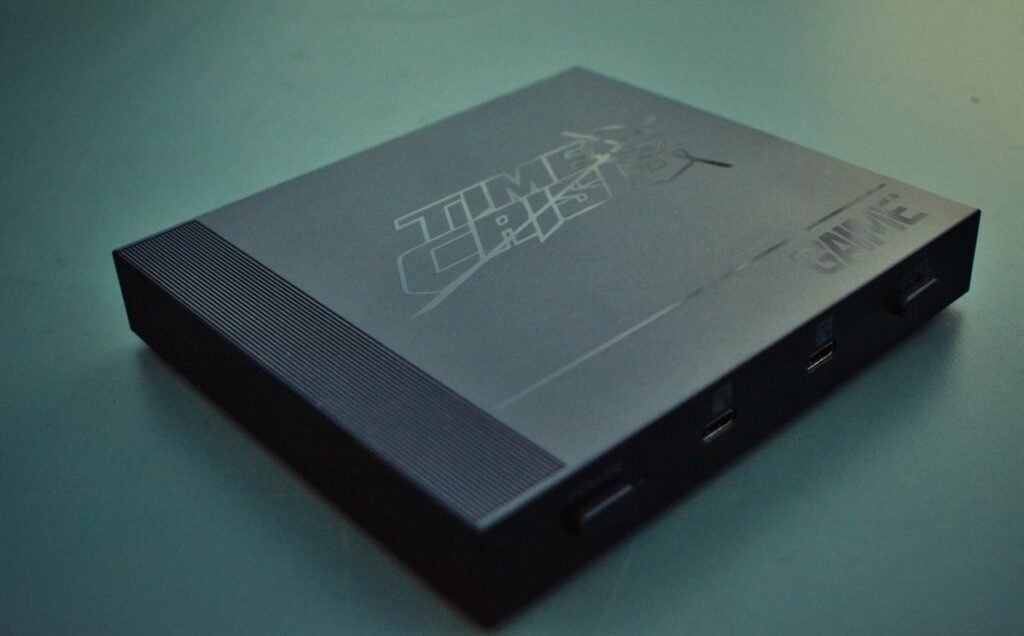
And as I haven’t had the pleasure of trying the Arcade1Up Time Crisis machine, the Tassei Denki project – a successful Kickstarter, released as G’AIME Time Crisis with various editions – seems like the best way to play the game with modern gear that hopefully won’t fall foul to wear and tear.
After all, I’ll be keeping it in a box.
What you get in the box
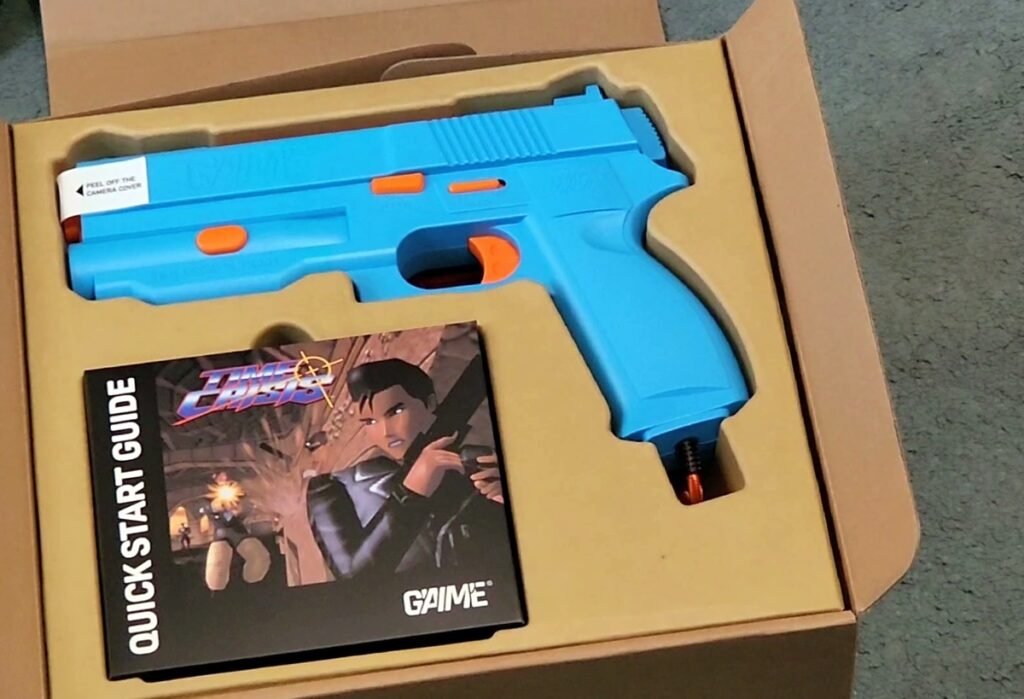
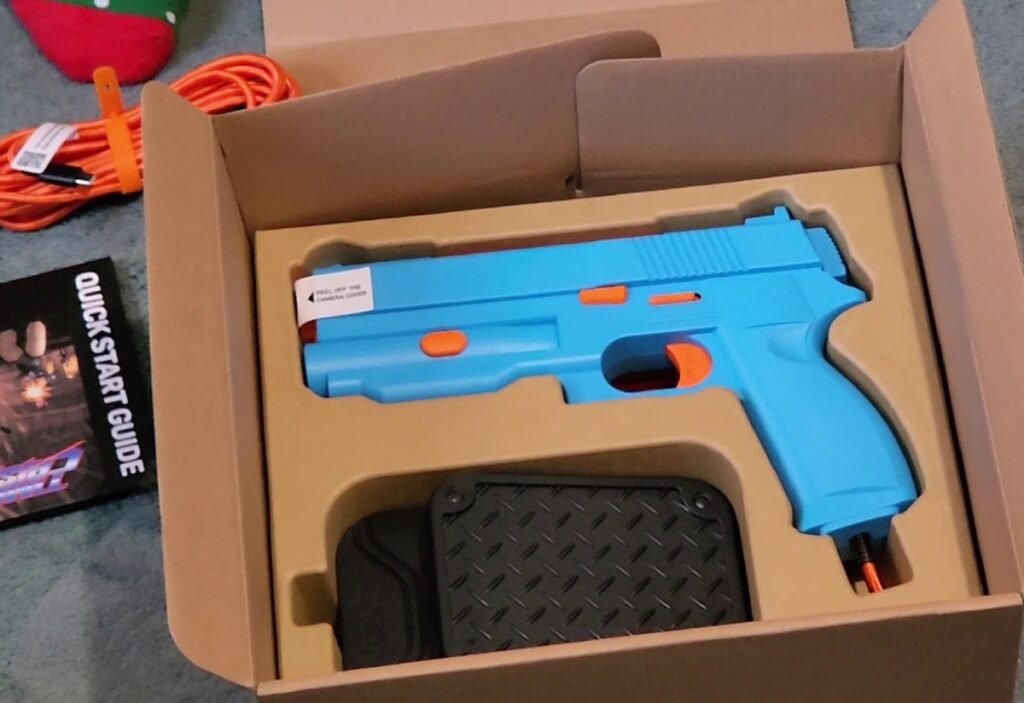
Several editions have been released, with single and dual gun setups. I’m reviewing the G’AIME Ultimate edition, which was limited to 200 sets. This features:
- Console unit
- 2x guns with 3 meter cables
- Pedal (3m cable) x1
- 1m power cable x1
- 1m HD cable x1
- AC adapter x1
- Instruction manual x1
- Collectable pin badge x1
- Collectable diorama stand x1
- Kickstarter exclusive keychain x1
It’s interesting to note that none of the publicity material, or the Kickstarter, explicitly states that the games run from a console unit. It runs the preinstalled Time Crisis, Point Blank, Steel Gunner, andSteel Gunner 2, but very little is known about it. We do know a bit about the guns, though. They’re blue and orange on the EU/UK Kickstarter editions (black on the Japanese release) and feature a half-inch camera, rumble solenoid, and there’s also a useful reset button, which may or may not help you out when it comes to calibration.
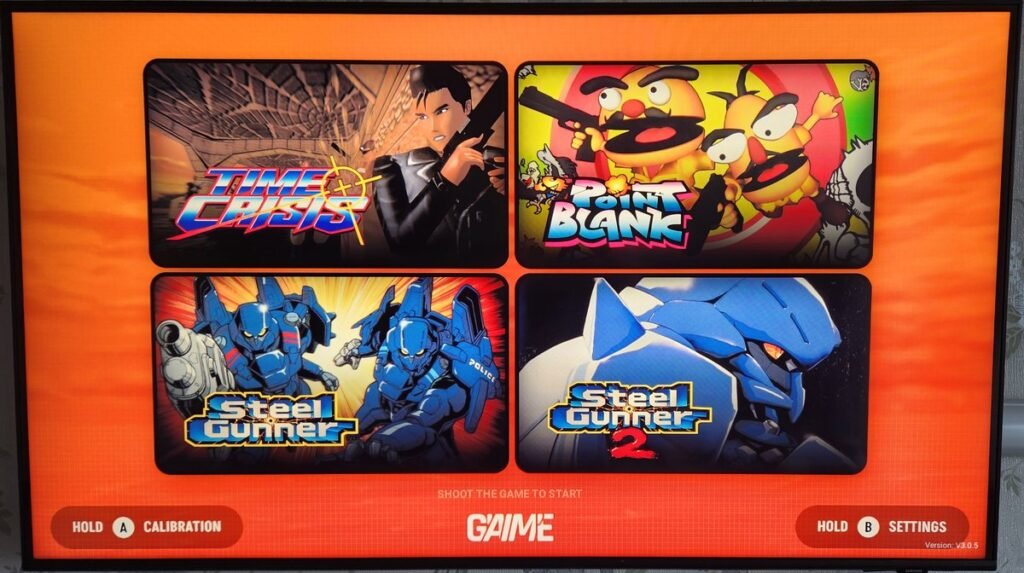
Unpacking the kit is a pleasing experience. You can see the care and attention that has gone into the arrangement of the guns and the pedal with in the box. The design of the interior is logical, giving you a gun and the console in the first tray if you want a quick set up, then the second gun and pedal on the next tray when you’re ready to bring a friend into the game.
I like it.
AI camera guns
The significant thing about this release is the AI light guns. CRT displays are more suited to traditional light guns, which is why a new, camera-based approach is required.
Modern TVs simply don’t work with light guns.
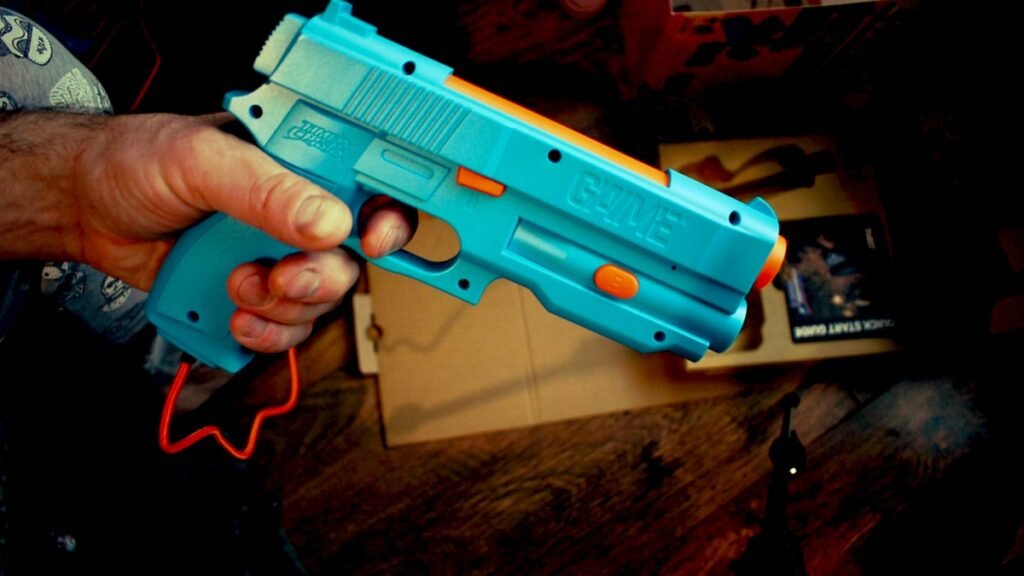
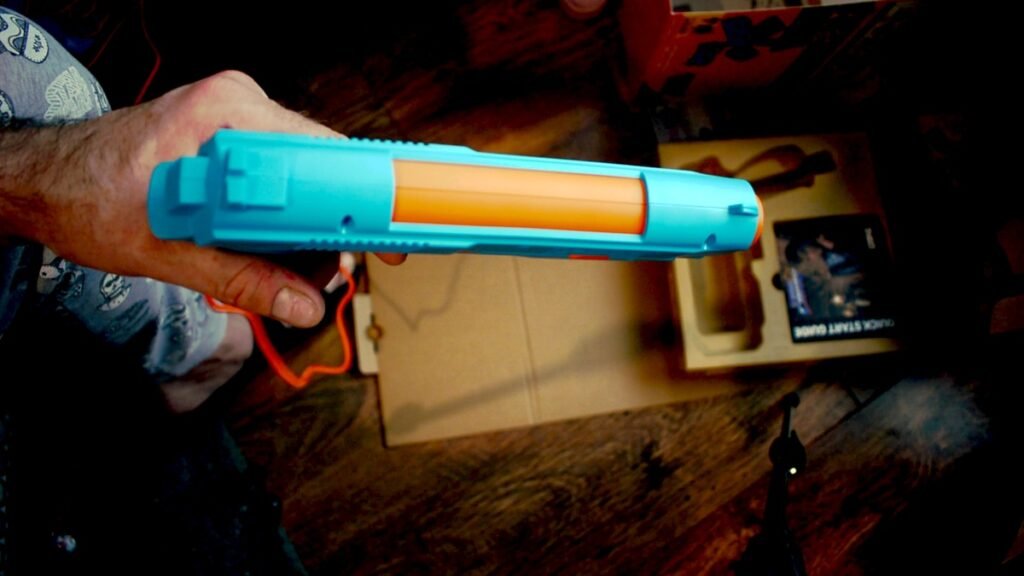
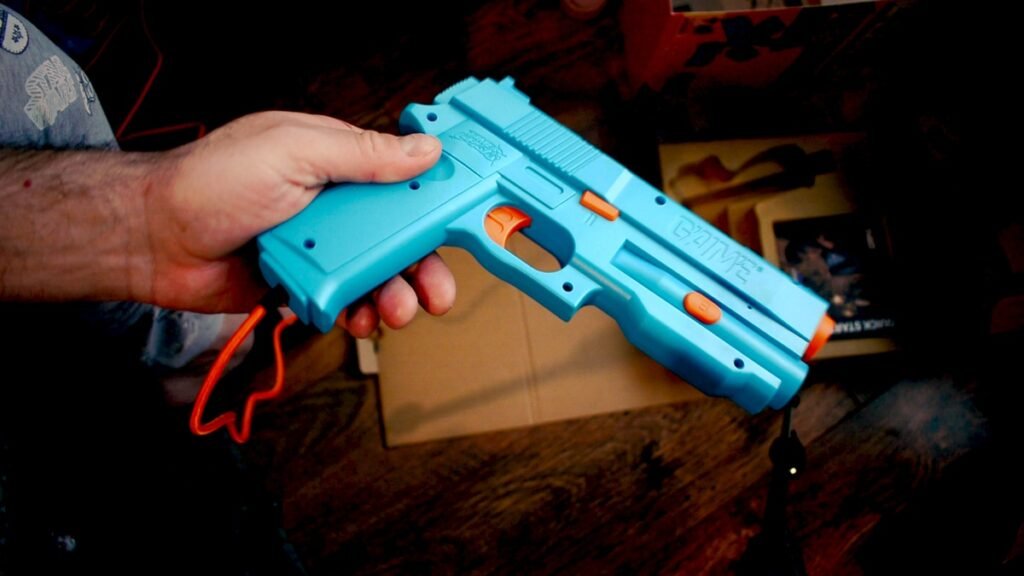
For example, if you had the PlayStation edition with the included light gun, you’re not going to have much fun playing with that on a modern TV.
So, mounted into each of these new AI light guns is a camera. This is then connected to a circuit board within the gun’s barrel, where the processing and logic takes place. Finally, this data is sent to the console, for further processing with the game — and all of that happens in a fraction of a second.
Latency is perhaps the thing I was most concerned about when I heard about this Kickstarter, but there is virtually none. In this regard, it offers an almost identical experience to the arcade machine.
But there are other factors.
Is your room too small for your TV?
You can’t play Time Crisis or the other games until you have calibrated the guns. This might seem fair enough, but there is a physical limitation to proceedings. A massive TV in a relatively small room is going to leave you unable to complete calibration – unless you stand outside the room.
There is a ratio for rooms and TV sizes that you need to meet for successful calibration (and by extension, game play), which is explained on the instruction booklet. However, I think it would be useful to have this information on the box, too.
In my case, the room is *just* big enough to accommodate distance required between a 46-inch TV and the position of the players. There is a small caveat though – the sofa is very tight against my calves. (It would be better to move it out of the way, but then that has its own consequences, such as “how does anyone leave the room?”)
While the console itself is pretty straightforward in a plug-and-play sense, it has a couple of quirks. First, is that you haven’t plugged the light gun and/or pedal in properly until you have heard a “click.” Second, the blue power light has a slight delay when powering on and off, so you need to be patient.
Actually playing Time Crisis with the AI light guns
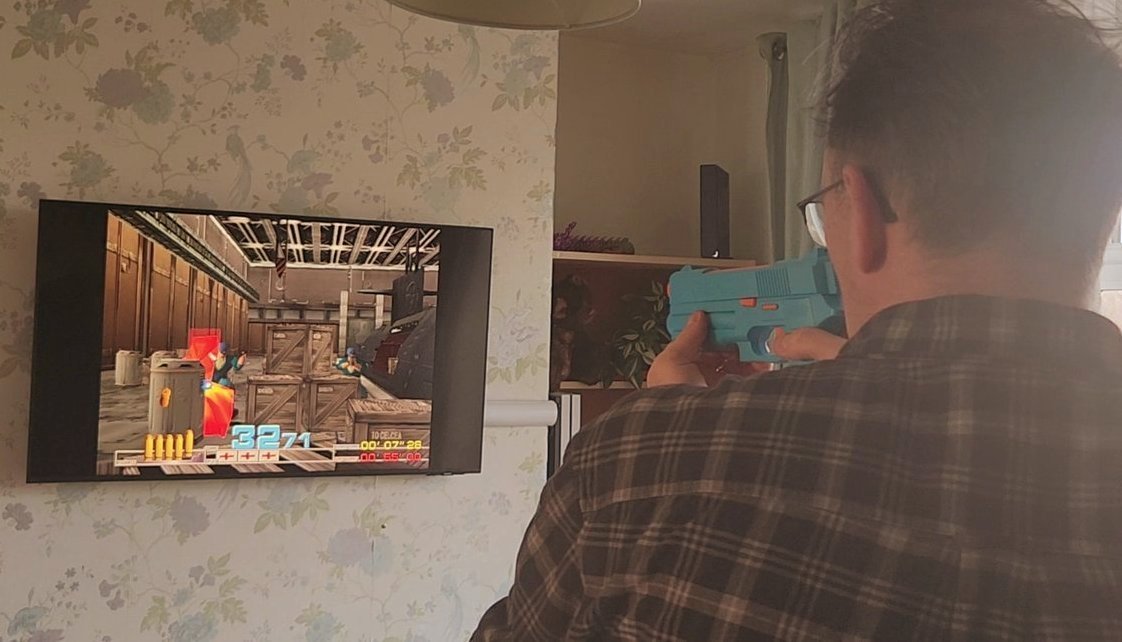
Of course, the point of this review is whether the AI light guns are any good. Well, there is only one answer: yes, they are.
Now, they’re not perfect, but then traditional light guns aren’t, and these modern iterations can at least be recalibrated if needed. This makes them useful for taking to a friend’s place, too, as the console is light and around the size of a CD case. While the light guns are of course a huge element of this product, its general portability and the selection of gaming alternatives should also be underlined. It’s a great package.
In terms of playability, the guns seem to have the right amount of heft, and accuracy is good – but that depends on whether you find yourself leaning or stepping forward. Playing with the pedal is a good option (the guns have a reload/cover button) but that’s only possibly with the Premium or Ultimate packs, as the standard edition doesn’t ship with a pedal. And while the console has two USB-C slots on the front (USB-C power input on the rear), and has a pedal “button” on the barrel, there is no two-player mode in Time Crisis, only in the other titles.
Initially, I found it difficult to get two shots consecutive shots to hit the same target with the light gun. I noticed this in Time Crisis, and tested it further in Point Blank… but it seems that I had made a bit of a rookie error.
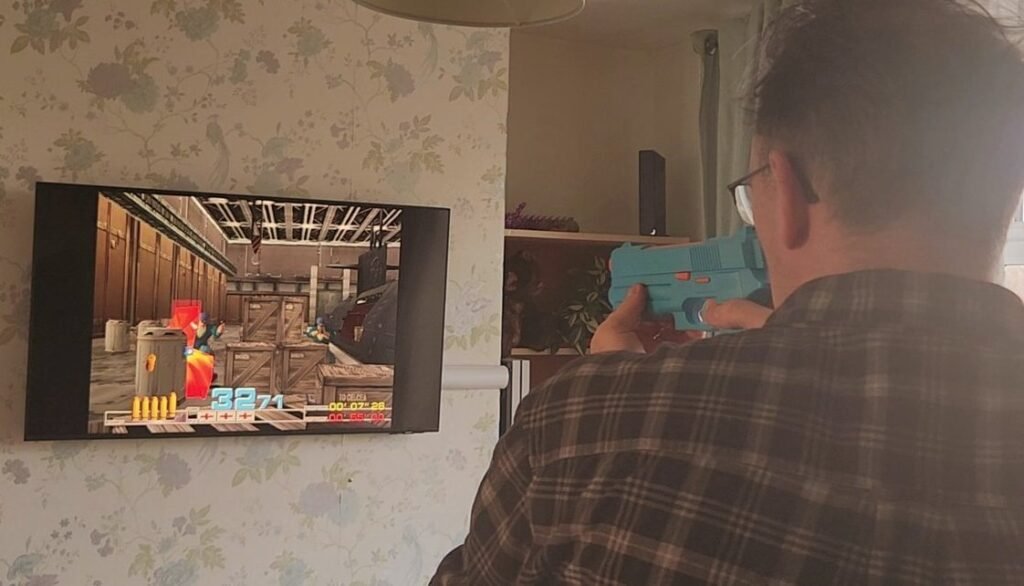
The light gun cameras come with protective labels over the lenses which needs removing before calibration, but this isn’t as easy as it sounds. I found that one of the guns still had its red-tinted adhesive over the lens despite removing the label, about a month after initially unwrapping, calibrating, and playing.
Let’s just say my aim improved noticeably from that point onward…
Should you get the G’AIME Time Crisis console and light guns?
This is an excellent re-presentation of Time Crisis for modern TVs. I’m not a huge fan of Point Blank, and the Steel Gunner games are nice to have, but ultimately forgettable. Time Crisis is one of the most significant arcade titles of the 1990s, and the fact that machines are still running and feature in retro arcades today really backs that up.
If Time Crisis is a game that got the adrenaline going for you in the 90s, and the arcade reproduction is out of your budget, this is a great alternative. I’d rather have this than a box in the corner of the room that I’m not going to play all the time.
But, there is a slight downside to all of this. As mentioned, it wasn’t clear that the G’AIME Time Crisis guns required their own. It would be amazing if these guns could be reworked for Switch 2 and PlayStation 5 and Xbox Series consoles, to run without the dedicated console. Perhaps that’s on the roadmap for Tassei Denki.
In the meantime, Time Crisis is a welcome addition to my game collection, but wow, it could have done with an authentic two-player mode.
Affiliate Disclosure: Some of the links in this post may be affiliate links, which means I may earn a small commission if you make a purchase through those links. This comes at no extra cost to you. Thank you for your support!

Christian Cawley is the founder and editor of GamingRetro.co.uk, a website dedicated to classic and retro gaming. With over 20 years of experience writing for technology and gaming publications, he brings considerable expertise and a lifelong passion for interactive entertainment, particularly games from the 8-bit and 16-bit eras.
Christian has written for leading outlets including TechRadar, Computer Weekly, Linux Format, and MakeUseOf, where he also served as Deputy Editor.
When he’s not exploring vintage consoles or retro PCs, Christian enjoys building with LEGO, playing cigar box guitar, and experimenting in the kitchen.